
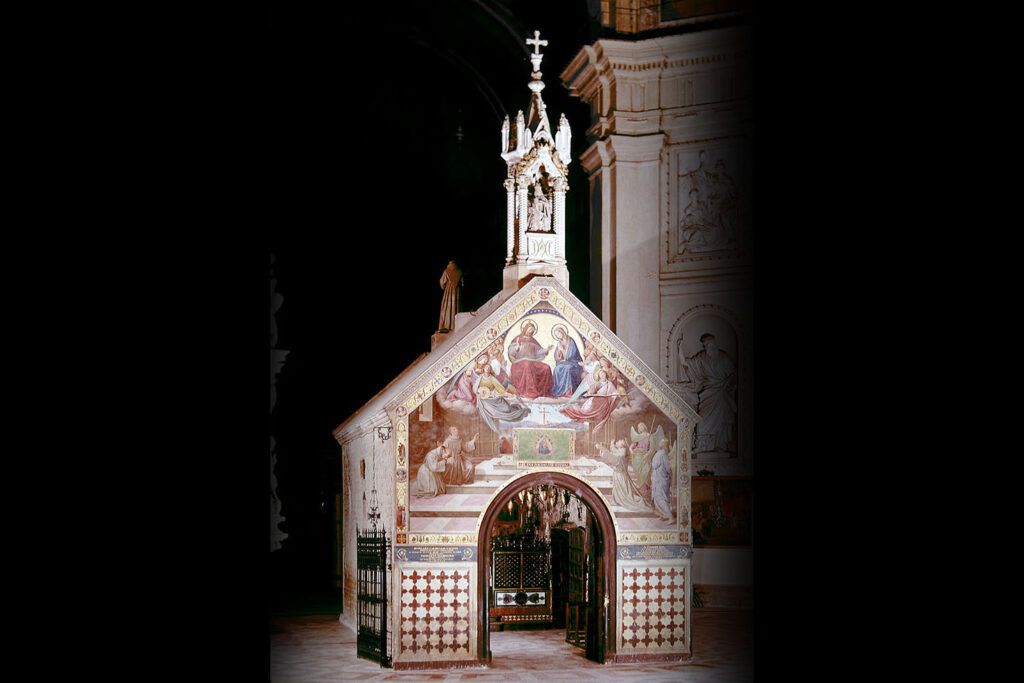
The Porziuncola ( “La Porziuncola”), a small, humble chapel located within the vast Basilica of Santa Maria degli Angeli in Assisi, is one of the most sacred and significant places in Franciscan spirituality. It’s not just a beautiful medieval structure; it’s the cradle of the Franciscan Order and the origin of one of the Catholic Church’s most profound spiritual gifts: the Pardon of Assisi (Porziuncola Indulgence). This small church, whose name literally means “little portion,” encapsulates a powerful message of poverty, humility, and divine mercy.
The history of the Porziuncola
The history of the Porziuncola is inseparable from the life of Saint Francis of Assisi. Originally, the chapel was a modest, ruined structure dating back to the 9th century, then owned by the Benedictine monks of Monte Subasio. After hearing the Gospel passage about the disciples being sent out to preach without provisions, Saint Francis realized his true calling was not to restore a physical church but to live a life of absolute poverty and evangelical preaching.
Around 1209, Francis and his first followers were granted use of the chapel. They restored it and made it their first true home and the original headquarters of the Franciscan Order. It was here that Francis received Clare of Assisi in 1211, marking the beginning of the Poor Clares. It was also near the Porziuncola Chapel that St. Francis dictated his spiritual will and, in 1226, breathed his last. To protect this holy site, a massive basilica, the Basilica of Santa Maria degli Angeli, was constructed around it between 1569 and 1679, effectively housing the little church like a precious relic.
The Forgiveness of Assisi: a gift of mercy
The most enduring legacy of the Porziuncola is the Pardon of Assisi, or Porziuncola Indulgence. According to tradition, in 1216, Saint Francis had a vision of Jesus and the Virgin Mary in the chapel. Jesus asked Francis what he desired for the salvation of souls. Francis humbly requested that anyone who confessed their sins, received communion, and entered the Porziuncola chapel on the specific day should receive a plenary indulgence—a complete remission of the temporal punishment due to sin.
Jesus granted the request, on the condition that Francis present it to the Pope for formal approval. Pope Honorius III formally approved the indulgence, which can now be obtained in the Porziuncola on August 2nd of every year, or on any other day by visiting any Franciscan church worldwide. This act of mercy is a testament to the chapel’s role as a source of radical forgiveness and grace.
Spiritual meaning: a place of reconciliation
The smallness of the Porziuncola is its greatest spiritual lesson. It stands as a powerful symbol of the Franciscan ideal: poverty, humility, and simplicity. It is a sanctuary where God’s infinite mercy is concentrated in a tiny “portion” of land. For pilgrims, entering the chapel is a physical act of stepping back into the origins of the Franciscan movement, a moment to reflect on the choice between the world’s grandeur and Christ’s humility. It is truly a place of reconciliation, offering a path to spiritual renewal through penance and forgiveness.
The interior: architecture and art of the Porziuncola
Despite its age and history, the Porziuncola is remarkably modest. Its rustic, simple structure reflects the aesthetic of the early Franciscan movement.
- Exterior: The façade is simple, topped by a small bell-gable. The exterior walls contain frescoes depicting scenes from the life of Saint Francis.
- Interior: The interior is characterized by its low ceiling and rough stone walls. The most important artistic feature is a stunning 14th-century fresco by Hilarion of Viterbo above the entrance, and a beautiful altarpiece by Father Ilario da Viterbo depicting the Annunciation. The contrast between the diminutive, austere chapel and the surrounding grandeur of the Basilica of Santa Maria degli Angeli only amplifies the spiritual power of the Porziuncola.
The Porziuncola today
Today, the Porziuncola remains a central pilgrimage site for Catholics and a beacon of hope. Millions of people travel to Assisi to visit the basilica, witness the humble chapel, and seek the Porziuncola indulgence. Although the original structure is now protected by the massive basilica, its spiritual resonance remains undiminished. It stands not only as a monument to Saint Francis but as a living testament to the possibility of divine mercy, forever inviting pilgrims to abandon worldly attachments and embrace a life of peace and profound humility.