
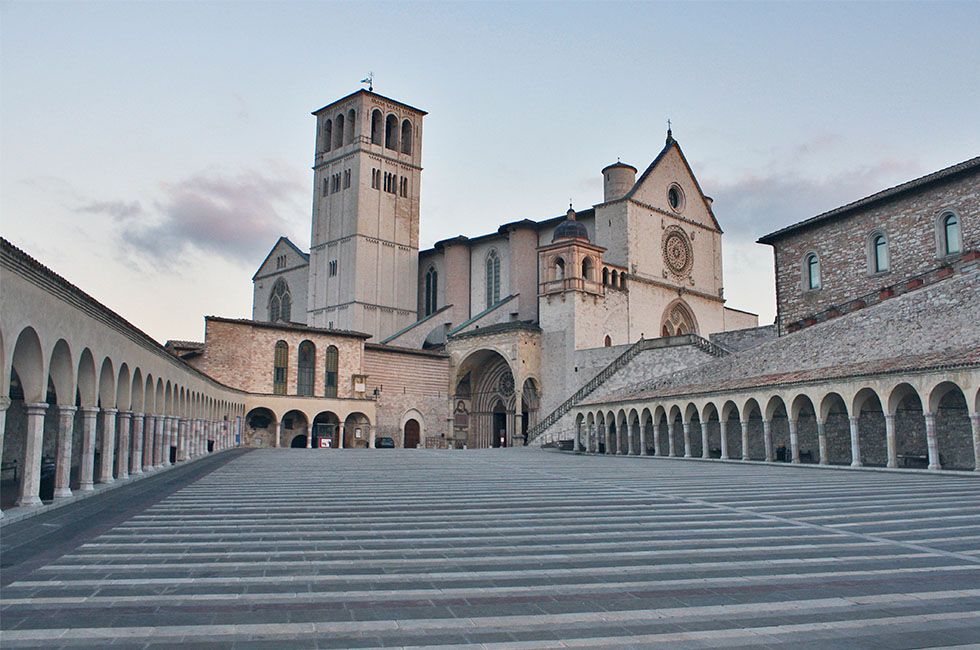
Discovering the sacred sites of Assisi: an itinerary between faith and art
Assisi, a small medieval town perched on the slopes of Mount Subasio in Umbria, Italy, is globally renowned as the birthplace of Saint Francis and Saint Clare. This heritage has cemented its status as a pilgrimage destination, making the churches in Assisi, not just places of worship but essential landmarks of history, art, and faith. A journey through Assisi is an immersive experience in sanctity, where every stone tells a story of devotion.
Basilica of Saint Francis of Assisi: the heart of Franciscan spirituality
Undeniably the most famous church in Assisi, the Basilica of St Francis is a masterpiece and a spiritual epicentre. Consecrated in 1253, the complex is actually two churches—the Upper Basilica and the Lower Basilica—built upon one another. The Upper Basilica is a striking example of Italian Gothic architecture, famed for the magnificent cycle of frescoes often attributed to Giotto, illustrating the life of Saint Francis. The Lower Basilica, older and more somber, hosts the tomb of the saint himself, offering a profound moment of reflection for pilgrims. This basilica is the cradle of the Franciscan order and an unparalleled testament to medieval art.
The Basilica of Saint Clare
Just a short walk from the main piazza, the St. Clare Church is a beautiful example of Italian Gothic. Built soon after the death of its namesake, the foundress of the Poor Clares, the church is instantly recognizable by its striking pink and white striped facade. Inside, the devotion to Saint Clare is palpable, and visitors can see the original crucifix of San Damiano, which is said to have spoken to Saint Francis, and the mortal remains of the saint.
Cathedral of San Rufino
The Cathedral of San Rufino is not just another church; it is Assisi’s main cathedral and a stunning display of Romanesque architecture. Its elaborate facade, adorned with three majestic rose windows and intricate carvings, is among the finest in Umbria. More importantly, this is where both Saint Francis and Saint Clare were baptized, making it a pivotal site in their spiritual journeys. The crypt beneath the church holds fascinating ruins of a Roman cistern and a previous church structure.
Basilica of Santa Maria degli Angeli
Located on the plain below the hill town of Assisi, the Basilica Santa Maria of the Angels in Assisi is physically separate but spiritually inseparable from the town. This enormous, majestic church was built to enclose the Porziuncola, the small, humble chapel that Saint Francis restored by hand and considered the spiritual heart of his movement. The Transito Chapel, where Saint Francis died in 1226, is also contained within the basilica, making it a must-visit site for any pilgrim.
Minor churches, hidden treasures
While the major basilicas draw the crowds, Assisi’s smaller, lesser-known churches offer glimpses into simpler Franciscan life and local history.
One such treasure is San Damiano Church. Situated outside the city walls, this small, rustic church and convent is where Francis heard the crucifix speak and where Saint Clare spent most of her life. It exudes an atmosphere of profound serenity and poverty, perfectly capturing the Franciscan ideal.
Other notable mentions include the Chiesa Nuova (built on the supposed site of Francis’s family home) and the small Oratorio di San Francesco Piccolino, believed to be his actual birthplace.
Assisi’s rich tapestry of sacred buildings ensures that a visit is more than just sightseeing; it’s a pilgrimage through the life and legacy of two of Christianity’s most beloved saints, beautifully preserved in art and stone.